
Definition
The term "fish" is most precisely used to describe any non-tetrapod chordate, i.e., an animal with a backbone that has gills throughout life and has limbs, if any, in the shape of fins. Unlike groupings such as birds or mammals, fish are not a single clade but a paraphyletic collection of taxa, including hagfishes, lampreys, sharks and rays, ray-finned fishes, coelacanths, and lungfishes.
A typical fish is cold-blooded; has a streamlined body that allows it to swim rapidly; extracts oxygen from the water using gills or an accessory breathing organ to enable it to breath atmospheric oxygen; has two sets of paired fins, usually one or two (rarely three) dorsal fins, an anal fin, and a tail fin; has jaws; has skin that is usually covered with scales; and lays eggs that are fertilized internally or externally.
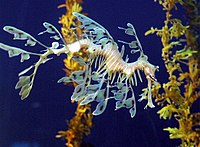
To each of these there are exceptions. Tuna, Swordfish, and some species of sharks show some warm-blooded adaptations, and are able to raise their body temperature significantly above that of the ambient water surrounding them. Streamlining and swimming performance varies from highly streamlined and rapid swimmers which are able to reach 10-20 body-lengths per second (such as tuna, salmon, and jacks) through to slow but more maneuverable species such as eels and rays that reach no more than 0.5 body-lengths per second. Many groups of freshwater fish extract oxygen from the air as well as from the water using a variety of different structures. Lungfish have paired lungs similar to those of tetrapods, gouramis have a structure called the labyrinth organ that performs a similar function, while many catfish, such as Corydoras extract oxygen via the intestine or stomach. Body shape and the arrangement of the fins is highly variable, covering such seemingly un-fishlike forms as seahorses, pufferfish, anglerfish, and gulpers. Similarly, the surface of the skin may be naked (as in moray eels), or covered with scales of a variety of different types usually defined as placoid (typical of sharks and rays), cosmoid (fossil lungfishes and coelacanths), ganoid (various fossil fishes but also living gars and bichirs, cycloid, and ctenoid (these last two are found on most bony fish. There are even fishes that spend most of their time out of water. Mudskippers feed and interact with one another on mudflats and are only underwater when hiding in their burrows. The catfish Phreatobius cisternarum lives in underground, phreatic habitats, and a relative lives in waterlogged leaf litter.
Fish range in size from the 16 m (51 ft) whale shark to the 8 mm (just over ¼ of an inch) long stout infantfish.
Many types of aquatic animals commonly referred to as "fish" are not fish in the sense given above; examples include shellfish, cuttlefish, starfish, crayfish and jellyfish. In earlier times, even biologists did not make a distinction - sixteenth century natural historians classified also seals, whales, amphibians, crocodiles, even hippopotamuses, as well as a host of aquatic invertebrates, as fish. In some contexts, especially in aquaculture, the true fish are referred to finfish to distinguish them from these other animals.
Classification
Fish are a paraphyletic group: that is, any clade containing all fish also contains the tetrapods, which are not fish. For this reason, groups such as the "Class Pisces" seen in older reference works are no longer used in formal classifications.
Fish are classified into the following major groups:
- Subclass Pteraspidomorphi (early jawless fish)
- Class Thelodonti
- Class Anaspida
- (unranked) Cephalaspidomorphi (early jawless fish)
- (unranked) Hyperoartia
- Petromyzontidae (lampreys)
- Class Galeaspida
- Class Pituriaspida
- Class Osteostraci
- (unranked) Hyperoartia
- Infraphylum Gnathostomata (jawed vertebrates)
- Class Placodermi (armoured fishes, extinct)
- Class Chondrichthyes (cartilaginous fish)
- Class Acanthodii (spiny sharks, extinct)
- Superclass Osteichthyes (bony fish)
- Class Actinopterygii (ray-finned fish)
- Class Sarcopterygii (lobe-finned fish)
- Subclass Coelacanthimorpha (coelacanths)
- Subclass Dipnoi (lungfish)
Some palaeontologists consider that Conodonta are chordates, and so regard them as primitive fish. For a fuller treatment of classification, see the vertebrate article.
The various fish groups taken together account for more than half of the known vertebrates. There are almost 28,000 known extant species of fish, of which almost 27,000 are bony fish, with the remainder being about 970 sharks, rays, and chimeras and about 108 hagfishes and lampreys. A third of all of these species are contained within the nine largest families; from largest to smallest, these families are Cyprinidae, Gobiidae, Cichlidae, Characidae, Loricariidae, Balitoridae, Serranidae, Labridae, and Scorpaenidae. On the other hand, about 64 families are monotypic, containing only one species. It is predicted that the eventual number of total extant species will be at least 32,500.


