
 Muhammad ibn ‘Abd Allāh (Arabic: محمد Muḥammad; (Mohammed, Muhammed, Mahomet) (c. 570 Mecca - June 8, 632 Madina), was the founder of Islam and is regarded by Muslims as the last messenger and prophet of God (Arabic: الله Allah), and is also regarded as a prophet by the Druze and as a Manifestation of God by the Baha'i Faith. Muslims do not believe that he was the creator of a new religion, but the restorer of the original, uncorrupted monotheistic faith of Adam, Abraham and others. They see him as the last and the greatest in a series of prophets of Islam.
 Sources on Muhammad’s life concur that he was born ca. 570 CE in the city of Mecca in Arabia. He was orphaned at a young age and was brought up by his uncle, later worked mostly as a merchant, and was married by age 26. At some point, discontented with life in Mecca, he retreated to a cave in the surrounding mountains for meditation and reflection. According to Islamic tradition, it was here at age 40, in the month of Ramadan, where he received his first revelation from God. Three years after this event, Muhammad started preaching these revelations publicly, proclaiming that "God is One", that complete "surrender" to Him (lit. islām) is the only way (dīn), acceptable to God, and that he was a prophet and messenger of God, in the same vein as Adam, Noah, Abraham, Moses, David, Jesus, and other prophets.
Muhammad gained few followers early on, and was largely met with hostility from the tribes of Mecca; he was treated harshly and so were his followers. To escape persecution, Muhammad and his followers migrated to Yathrib (Medina) in the year 622. This historic event, the Hijra, marks the beginning of the Islamic calendar. In Medina, Muhammad managed to unite the conflicting tribes, and after eight years of fighting with the Meccan tribes, his followers, who by then had grown to ten thousand, conquered Mecca. In 632, on returning to Medina from his 'Farewell pilgrimage', Muhammad fell ill and died. By the time of his death, most of Arabia had converted to Islam.
The revelations (or Ayats, lit. Signs of God), which Muhammad reported receiving till his death, form the verses of the Qur'an, regarded by Muslims as the “word of God”, around which the religion is based. Besides the Qur'an, Muhammad’s life (sira) and traditions (sunnah) are also upheld by Muslims.
Sources for Muhammad's life
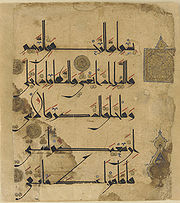
From a scholarly point of view, the most credible source providing information on events in Muhammad's life is the Qur'an. The Qur'an has some, though very few, casual allusions to Muhammad's life. The Qur'an, however, responds "constantly and often candidly to Muhammad's changing historical circumstances and contains a wealth of hidden data that are relevant to the task of the quest for the historical Muhammad." All or most of the Qur'an was apparently written down by Muhammad's followers while he was alive, but it was, then as now, primarily an orally related document, and the written compilation of the whole Qur'an in its definite form was completed early after the death of Muhammad. The Qur'an in its actual form is generally considered by academic scholars to record the words spoken by Muhammad because the search for variants in Western academia has not yielded any differences of great significance.
Next in importance are the traditional Muslim biographies of Muhammad and quotes attributed to him (the sira and hadith literature), which provide further information on Muhammad's life. The earliest surviving written sira (biographies of Muhammad and quotes attributed to him) is Ibn Ishaq's Sirah Rasul Allah (Life of God's Messenger). Although the original work is lost, portions of it survive in the recensions of Ibn Hisham (Sirah al-Nabawiyyah, Life of the prophet) and Al-Tabari. According to Ibn Hisham, Ibn Ishaq wrote his biography some 120 to 130 years after Muhammad's death. Many, but not all, scholars accept the accuracy of these biographies, though their accuracy is unascertainable. The hadith collections, accounts of the verbal and physical traditions of Muhammad, date from several generations after the death of Muhammad. Western academics view the hadith collections with caution as accurate historical sources.


